Search is changing quickly. Customers are no longer only typing a short phrase into Google and clicking through a list of blue links. They are also asking detailed questions, comparing options through AI-powered search experiences, and expecting useful answers before they ever visit a website.
For a small business, that raises an important question: How do you make sure your business can still be found when search engines use AI to answer the customer’s question?
The good news is that you do not need to throw out everything you know about SEO. In fact, Google’s current guidance is surprisingly straightforward: strong SEO fundamentals still matter in generative AI search. The businesses that make their websites useful, trustworthy, technically accessible, and locally accurate are building the same foundation needed for visibility in AI-powered search.
What Does “AI Search” Mean for a Small Business?
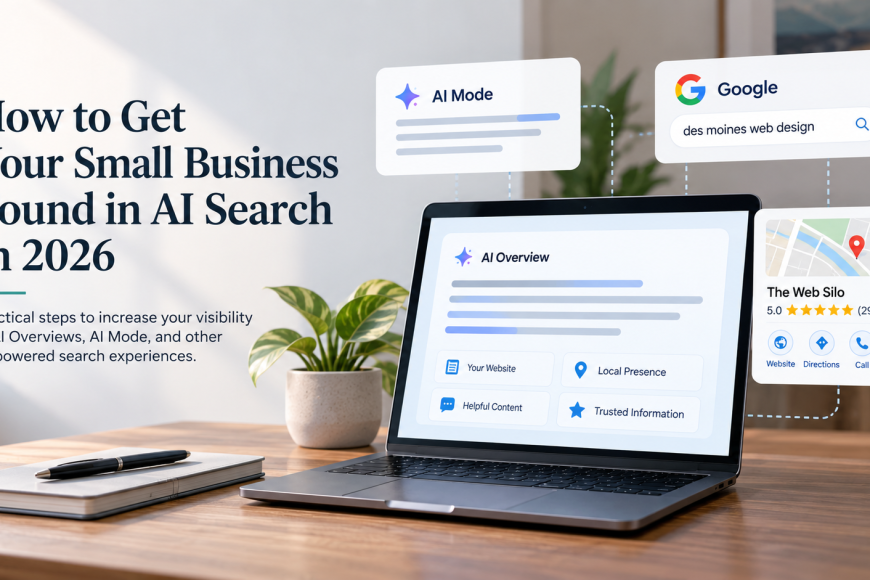
AI search describes search experiences that use generative AI to assemble an answer from multiple sources instead of simply presenting a traditional list of results. Google’s AI Overviews and AI Mode are two prominent examples.
These systems may break a complicated question into several related searches, retrieve relevant information, and use those sources to produce a response. Google calls one part of this process “query fan-out.” That means a business may have an opportunity to appear even when its page does not contain the exact wording a customer typed.
For example, someone might ask:
- Who is a reliable web designer for a small business in Des Moines?
- How can I get more local customers without spending a fortune on advertising?
- What should I fix if my business is not appearing in Google Maps?
- Should a local business invest in SEO or Google Ads first?
Those are not simple keyword searches. They are questions that require context. A website that clearly demonstrates what the business does, where it operates, what problems it solves, and why its information can be trusted gives search systems more useful information to work with.
SEO Is Still the Foundation of AI Search Visibility
There is a growing list of terms around AI search, including AEO (Answer Engine Optimization) and GEO (Generative Engine Optimization). They can be useful ways to describe the changing search landscape, but small businesses should be cautious about treating them as replacements for SEO.
Google’s own guidance for generative AI search says that traditional SEO best practices remain relevant because Google’s generative search features rely on its core search ranking and quality systems.
In practical terms, that means your first priorities should still include:
- A website that search engines can crawl and index.
- Useful pages that clearly explain your services.
- Accurate local business information.
- Strong internal links between related pages.
- Original content based on real expertise.
- A good experience on mobile and desktop devices.
- Structured data that accurately reflects the visible content when appropriate.
There is no special AI schema that magically makes a business appear in an AI answer. Google also says that special AI files such as llms.txt are not required for visibility in Google Search.
1. Make Your Business Easy to Understand
An AI system cannot confidently recommend or cite a business if the basic information about that business is confusing.
Your website should make several things obvious: who you are, what you do, who you serve, where you operate, and how someone can contact you. Your service pages should use the language customers actually use rather than relying on vague marketing phrases.
For a local business, location also matters. Your website, contact information, service-area information, and Google Business Profile should tell a consistent story.
If local visibility is already a problem, start with our Des Moines SEO guide and make sure the fundamentals are in place before chasing new AI-search tactics.
2. Publish Information That Comes From Real Experience
Generic content is becoming easier than ever to produce. That makes firsthand knowledge more valuable, not less.
A useful local business article should contain something that could realistically come from your experience with customers. That might include common mistakes you see, questions customers repeatedly ask, examples of how you solve a problem, local considerations, original photographs, or a clear professional opinion.
Consider the difference between these two topics:
Generic: “10 Tips for Maintaining Your Home.”
Experience-driven: “5 Maintenance Problems We Commonly Find in Des Moines Homes Before Winter.”
The second topic gives the business an opportunity to contribute knowledge that is specific, useful, and difficult to duplicate without actual experience.
This aligns with Google’s emphasis on what it calls non-commodity content: information that offers genuine value rather than simply repeating what is already available everywhere else.
3. Answer the Questions Customers Ask Before They Call
Your sales conversations are one of your best content-research tools.
Write down the questions customers ask before hiring you. Pricing questions, comparisons, misconceptions, preparation questions, timelines, warning signs, and “do I really need this?” questions can all become useful website content.
This works particularly well for AI-driven search because people are becoming more conversational in how they search. Instead of searching for two or three keywords, they can ask a detailed question that includes their situation and what they are trying to accomplish.
You do not need a separate page for every slight variation of a question. Build substantial resources that address a topic well and organize them with descriptive headings so both visitors and search systems can understand the page.
4. Keep Your Google Business Profile Accurate
For local businesses, your website is only part of your online identity. Your Google Business Profile helps Google understand important information such as your business category, location, hours, services, reviews, and contact details.
Google specifically recommends keeping Business Profile information current when optimizing for generative search experiences.
That means AI visibility and local SEO should not be treated as separate projects. If your website says one thing while your Business Profile says another, you are creating unnecessary ambiguity.
If you need to work on that foundation, see our guide on Google Business Profile optimization.
5. Build Clear Connections Between Your Pages
Internal links help visitors discover related information, and they also help search engines understand the structure of your website.
A service page might link to a detailed guide answering a common customer question. That guide might link to another article explaining a related issue and then back to the relevant service or contact page.
The goal is not to stuff links everywhere. The goal is to build a website where related information naturally connects.
Think of your website as a knowledge base about your business rather than a collection of isolated pages.
6. Make Sure Important Information Is Actually Accessible
A beautiful website is not useful to search engines if important information cannot be reliably crawled or understood.
Key business information should be available as actual text on the page. Your site should work well on mobile devices, load reasonably quickly, use descriptive page titles and headings, and avoid accidentally blocking important pages from search engines.
Technical SEO becomes even more important as search evolves because AI-powered search still needs accessible source material.
7. Don’t Chase AI Search “Hacks”
Whenever technology changes, shortcuts appear almost immediately.
Small businesses should be skeptical of anyone promising guaranteed placement in AI answers or selling a secret markup that supposedly unlocks AI visibility. Google currently says there are no additional technical requirements for appearing as a supporting link in AI Overviews or AI Mode beyond being eligible for Google Search.
That does not mean AI search optimization is meaningless. It means the useful work is less glamorous: improve your website, demonstrate expertise, keep business information accurate, create content customers genuinely need, and make everything easy for search engines to access.
What Should a Small Business Do First?
If you are trying to prepare your business for AI search, start with this order:
- Fix your foundation. Make sure your site can be crawled, indexed, and used comfortably on mobile devices.
- Clarify your services. Give each important service enough information for a customer to understand what you offer.
- Strengthen your local signals. Keep your Google Business Profile and website information accurate and consistent.
- Turn customer questions into useful content. Focus on questions that demonstrate your actual experience.
- Connect related information. Build useful internal links between services, articles, tools, and conversion pages.
- Measure the results. Watch Search Console, website traffic, leads, and conversions rather than relying on a single “AI ranking” score.
AI Search Doesn’t Replace Good Marketing
The search interface may change, but the underlying business objective has not: help the right customer understand why your company is a credible solution to their problem.
Small businesses do not need to publish hundreds of AI-generated articles or rebuild their websites around the latest acronym. They need a strong digital foundation and genuinely useful information that reflects what they know.
That is good SEO. It is also increasingly good AI-search optimization.
How Visible Is Your Business in AI Search?
If you are wondering how prepared your current online presence is, The Web Silo has a free AI Search Visibility Grader designed for local businesses. Use it to get a quick look at your current visibility and identify areas that may deserve attention.
And if your website, local SEO, or overall digital presence needs more than a quick fix, contact The Web Silo. We help small businesses build a stronger online presence without unnecessary agency overhead.